Ecosystem Registry Full Map

SourceEcosystem

Source is not a fragmented collection of point services. It is a highly coordinated ecosystem of growth, trust, workflow automation, interface design, data intelligence, and private hosting substrates built to power the Lead Engine.

16 Systems
08 Operating Layers
One Lead Engine
Ecosystem Strategy

Ecosystem Breadth, Focused Activation.

Do not waste capital purchasing disjointed agency retainers. The Source ecosystem groups specialized capabilities into four coordinated divisions. We audit your pipeline leaks, deploy the highest-priority engine configuration first, and expand only when profitable.

1. Locate the Weakness

Whether you need Google/Map visibility, instant callback response, or review momentum, our baseline diagnostic identifies the highest-leverage beginning point.

2. Start Bounded

We activate only the specific systems needed to address that pressure point. No redundant tools, no bloated setup cycles, and no manual coordination overhead.

3. Expand as You Scale

Once your baseline conversion engine is secure, seamlessly layer in back-office automations, outbound syndication, custom portal interfaces, and private substrates.

Operational Taxonomy

Four Core divisions.
One Coordinated Pipeline.

Source groups its 16 capability components into four distinct functional divisions. This architecture ensures that buyer-facing assets work in perfect alignment with background automation and infrastructure substrates.

Division A

Growth & Trust

The public discovery and authority engines of the business. Captures marketplace attention and structures it into visible, compounding trust signals.

Representative Systems:Reviews, SEO, Outreach
Key Output Target:Marketplace attention & proof

Lead Engine Role:Feeds high-intent traffic and local organic leads into intake gates, backed by visible social credibility.


Division B

Automation & Intelligence

The workflow runtime layers. Converts raw prospect intake events into structured opportunities using bounded AI labor and data pipelines.

Representative Systems:Automate, Worker, Integrate, Data Sci
Key Output Target:Intake protection & labor loops

Lead Engine Role:Automates lead contact responses in under 60 seconds and syncs interaction logs with backend databases.

Division C

Build & Experience

The high-fidelity acquisition interface layer. Builds conversion-focused web layouts, customer portals, and corporate asset structures.

Representative Systems:Web Design, UI, Mobile, Programming, Graphic
Key Output Target:Client interface assets

Lead Engine Role:Establishes high-performance public surfaces that capture user inputs and secure visual authority.

Division D

Infrastructure & Enablement

The system foundation. Provides secure private runtime servers, onboarding integration protocols, and operator documentation libraries.

Representative Systems:VPS, PC Workstations, Onboard, University
Key Output Target:Data containment & training

Lead Engine Role:Hosts secure client databases, protects intellectual property, and certifies your operators on runbooks.

Live Topology · 16 Systems Online
Ecosystem Blueprint

Ecosystem Atlas

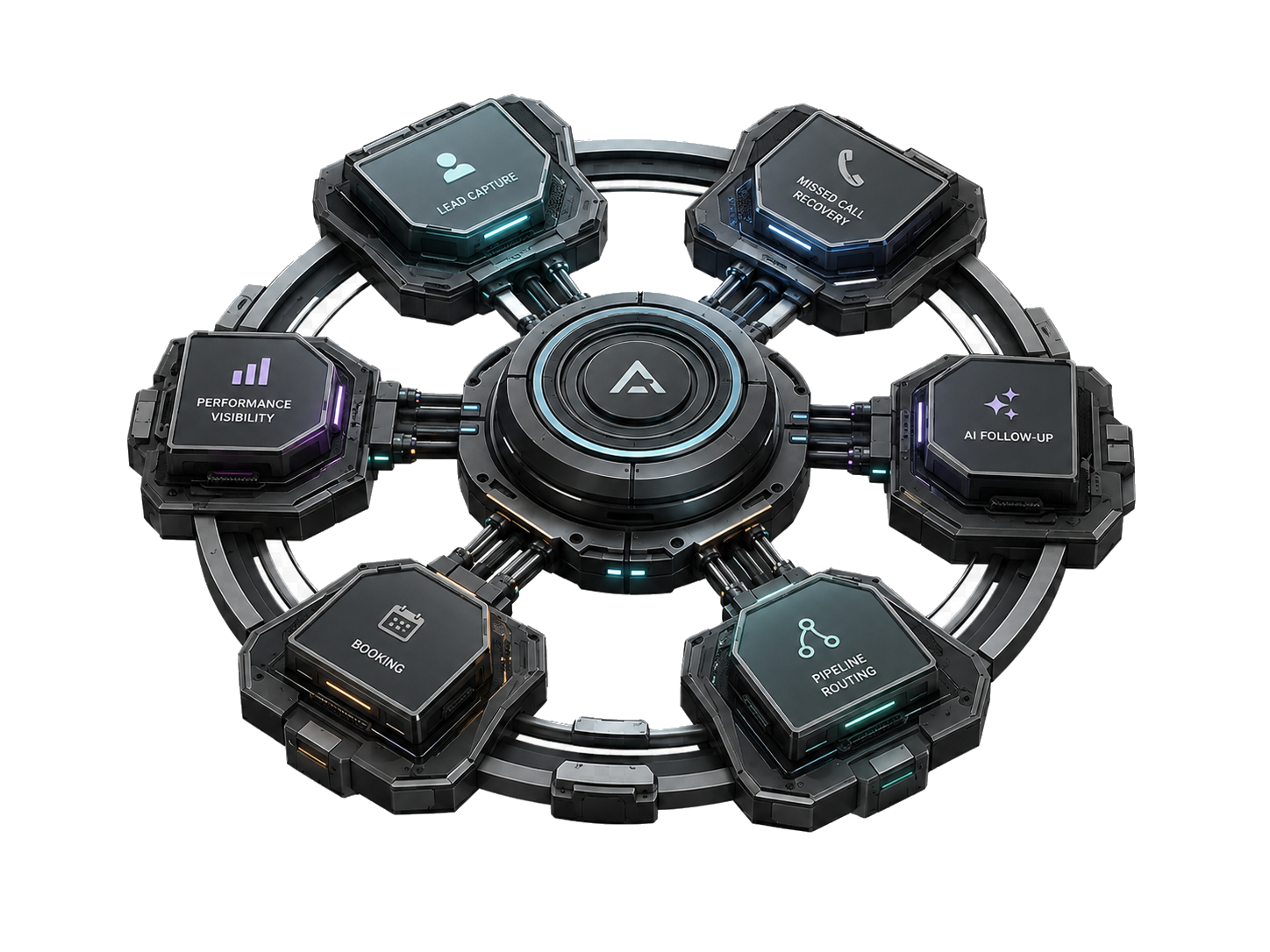
An architectural rendering of the unified Source capability divisions. Growth, Automation, Build, and Infrastructure nodes orbit the central Source Lead Engine core and synchronize through encrypted local databases.

A Growth & Trust 3 SYS
B Automation & Intelligence 4 SYS
C Build & Experience 5 SYS
D Infrastructure & Enablement 4 SYS
Atlas Topology: Four division panels connect to a single Source Lead Engine core through encrypted database links. Each panel can be activated independently while sharing state with the rest of the network.
Hover a node or division row to inspect details
Division A · Growth & Trust

Feeds high-intent traffic and local organic leads into intake gates, backed by visible social credibility.
ReviewsSEOOutreach
Output Marketplace attention & proof
Division B · Automation & Intelligence

Automates lead contact responses in under 60 seconds and syncs interaction logs with backend databases.

AutomateWorkerIntegrateData Sci
Output Intake protection & labor loops
Division C · Build & Experience

Establishes high-performance public surfaces that capture user inputs and secure visual authority.

Web DesignUIMobileProgrammingGraphic
Output Client interface assets
Division D · Infrastructure & Enablement

Hosts secure client databases, protects intellectual property, and certifies operators on runbooks.

VPSPC WorkstationsOnboardUniversity
Output Data containment & training
CORE SOURCE LEAD ENGINE ACTIVE · 16 SYS
A Growth & Trust 3 SYSTEMS Reviews · SEO · Outreach
B Automation 4 SYSTEMS Automate · Worker · API · Data
C Build & UI 5 SYSTEMS Web · UI · Mobile · Code · Graphic
D Infrastructure 4 SYSTEMS VPS · PC · Onboard · Univ.
4 Divisions
16 Systems
8 Active Routes
Encrypted Local DB
Ecosystem Registry

Specialized Capabilities.
Configure the Details.

Explore the full capability index. Select a division tab to filter systems, then click any card to reveal details, featured modules, solution contributions, and planned implementation routing coordinates.

Pipeline Flow

The Operating Path.
Connective Progression.

Specialized modules do not operate in silos. They sequence sequentially, passing conversion signals from organic discovery to database onboarding, and continuous relationship reactivation.

01

Discover

SEO, Web Design, and Outreach establish public visibility.

02

Trust

Reviews and Graphic Design compound authority.

03

Capture

Interface and Integrate modules lock in prospect inputs.

04

Respond

Automate workflows capture hot interest in under 60 seconds.

05

Operate

Integrate and VPS configurations execute recurring pipeline tasks.

06

Prove

Data Science and Reviews modules output verifiable records.

07

Compound

Outreach and University pathways reactivation old database records.

08

Expand

Secure PC setups, VPS clusters, and custom App nodes expand boundaries.

Shared Infrastructure

Horizontal System Layers.
Unified Substrates.

Cross-engine layers represent background capabilities that extend across multiple solutions. Instead of acting as front-door products, they provide the necessary data and runtime foundations.

Back-Office Execution

Cross-EngineLayers

Infrastructure and intelligence layers that maintain the pipeline's posture, protect data, and enable human operator synchronization.

X01
Source WorkerBounded role-based AI labor assistants for repeatable tasks.
AI Labor
X02
Source IntelligenceReal-time signal analysis, conversion priority, and reports.
Insights
X03
Source UniversityEnablement runbooks, training documentation, and guides.
Enablement
X04
Source VPSPrivate server nodes providing runtime sandboxes for integrations.
Substrate
Integrated Outputs

Modules BecomeOutcome Engines

We combine modular systems from the ecosystem into outcome-focused Engines mapped to specific buyer problems.

01 Ingress

Public surfaces where prospects first contact the Lead Engine. SEO landing pages, web properties, reputation funnels, and outbound recall campaigns.

Source SEO Source Reviews Source Outreach Web Design
02 Routing

Event routing and integration. Connects intake signals to downstream engines and syncs CRM, scheduling, and back-office systems without manual handoff.

Source Automate Source Integrate
03 Labour

Bounded AI labor and intelligence operations. Performs repeatable back-office work, classifies signals, and prioritizes qualified opportunities under operator review.

Source Worker Source Intelligence
04 Substrate

Private runtime substrate. Hosts automation, isolates client data, and ensures low-latency execution outside public cloud handoff.

Source VPS Source University PC Workstations
System Machinery

Runtime Stack

The Source Lead Engine operates as a four-layer runtime stack. Operations begin on a private substrate, ascend through bounded AI labour and event routing, and resolve at the public ingress surface.

Input
Web forms, review funnels, outbound campaigns, API webhooks
Process
Bounded AI labour with operator override at every layer
Output
60-second callbacks on urgent events, observable layer handoffs
Architecture Clarifier

Ecosystem vs. Solutions.
Distinct Roles.

It is critical to distinguish between Solutions and the Ecosystem to avoid system duplication and identify the correct starting points. Solutions are the outcome engines you purchase; the ecosystem is the substrate that powers them.

Outcome Engines
01

SolutionsThe Customer Outcome

Customer-facing engines configured to solve immediate business problems. They are the outcome you purchase to fix specific pipeline failures — applied as a unit, billed per result.

Response Recovery Demand Conversion Visibility & Authority Reputation & Retention AI Workforce Ops
Modular Substrate
02

EcosystemThe Operating Substrate

The underlying modules, automations, and servers that power those engines. The ecosystem is the codebase and substrate you license — components that may be reused across multiple solutions during implementation.

Source VPS Source Worker Source Automate Source Integrate Source SEO / Reviews / Outreach Source University
Integration Matrix

System-to-Solution Bridge.
Modular Mapping.

Review the mapping below to see how specific ecosystem systems support and implement the outcome solutions of the Source Lead Engine.

Ecosystem System Supports Solution Engines Typical Role Visibility Layer
Source SEO Visibility + Authority / Demand

Organic visibility, local search standing, maps rankings.

Public Ingress
Source Reviews Reputation + Retention / Visibility

Trust signal harvesting, public proof page loops.

Public Ingress
Source Outreach Reputation + Retention / Demand

Dormant client recall, syndicated outbound campaigns.

Public Ingress
Source Automate Response Recovery / AI Workforce

Urgent 60-second callback sequences and alerts.

Public / Private
Source Worker AI Workforce / Response Recovery

Bounded back-office AI labor and data logging assistants.

Private Layer
Source Integrate All Engines

Connective database tunnels, API syncs, webhook logic.

Private Layer
Source VPS AI Workforce / Response Recovery

Dedicated server virtualization and runtime containment.

Private Layer
Source University All Engines

Continuous education platforms, runbooks, operator manuals.

Enablement
Advanced View

Technical Schematics.
Operating Projections.

01 / State Model System Lifecycle States
02 / Layer Model Public vs. Private Routing
03 / Event Router Signal Processing Paths
04 / Substrate Config Server Container Limits
05 / Compliance Guards Claim Safeguard Thresholds
01 / State Model Projection Monitor

System Lifecycle States

Ecosystem modules operate across five distinct development phases to ensure controlled deployment.

Lifecycle State Operational Parameters Target Posture
Dormant Codebase asset resting in local repositories, zero server resource footprint. Offline
Active System active, collecting lead inputs and executing responses. Active
Synced Data flows fully integrated with third-party CRMs and APIs. Integrated
Optimized A/B conversion targets met, automated latency thresholds audited. Stable
Scaling VPS clustering active to support high-volume marketplace workloads. Scale

Public vs. Private Routing

Traffic passes through public conversion surfaces before hitting private database logic.

Layer Name Modules Included Security Standard
Public Ingress Web Design, SEO, Outreach, Reviews, Interfaces SSL / Web Firewalls
Routing Middleware Integrate Webhooks, SMS callbacks, Automate logic Encrypted APIs
Private Substrate Worker, Data Science, VPS database clusters VPC / Private Key

Signal Processing Paths

How events route from customer intake channels to automated backend systems.

Event Source Target Destination Response Latency
Inbound Form Submission Automate → Lead Sync Tunnel → CRM < 100ms
Missed Call Event Automate SMS Text-back Loop < 60 seconds
Data Query Event Worker Analysis → Data Science Console < 500ms

Server Container Limits

Operational thresholds configured inside our private VPS environments.

Substrate Parameter Baseline Limit Expansion Policy
Database Connections 1,000 Concurrent sessions Auto-Scaling
AI Worker Latency Max 2,000ms response window Parallel Processing
Uptime target 99.9% Operational availability Clustered Nodes

Claim Safeguard Thresholds

Ecosystem guardrails protecting compliance boundaries and ensuring system safety.

Compliance Rule System Boundary Action Status
No Guaranteed Income Audit copy to refer strictly to capability/metrics. Enforced
Bounded AI Labor Mandatory human verification gates for outgoing payments. Enforced
Attribution Caps Do not claim absolute 100% conversion attribution. Guided
Ecosystem Access

Do Not Guess Your Starting Point

You do not need to choose which of the 16 ecosystem modules to build first. Our pipeline assessment analyzes your conversion surfaces, latency bottlenecks, and review posture to identify the exact weakest link.

Precision Activation

Activate the Correct Configuration.

Start with the high-impact system that addresses your core pipeline leakage. Expand into the wider ecosystem only when profitable and verified.